
Grid and Voronoi are not just visual styles. They change solve behavior, production cost, and the kind of user experience you are creating.
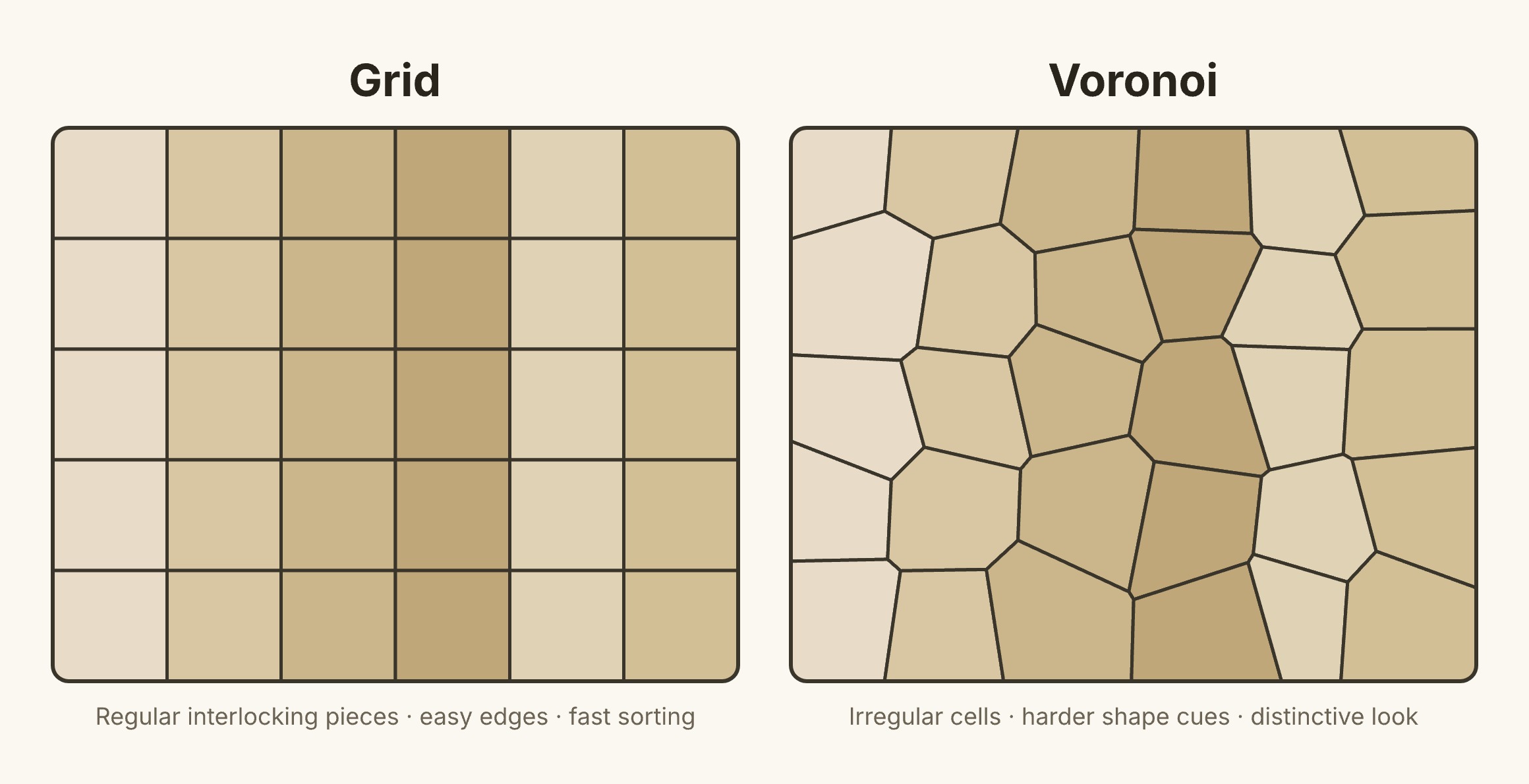
As the diagram shows, Grid pieces repeat a familiar interlocking shape, while Voronoi pieces are irregular cells with far less repetition. That single difference drives most of the trade-offs below.
If you want the simplest rule, use Grid for faster onboarding and paper-friendly workflows, and use Voronoi when you want a more distinctive or maker-oriented puzzle style.
Choose Grid when...
- the puzzle is meant for beginners
- you want a classroom or printable activity
- you care about fast edge building and easier sorting
- you need a more predictable production workflow
Grid is usually the safer default because the shape language is more familiar and easier to explain.
Choose Voronoi when...
- you want the puzzle to feel more distinctive
- you want higher challenge without only increasing piece count
- you are making a gift, premium edition, or boutique product
- you are already working in a more maker-oriented export workflow
Voronoi usually feels less predictable, which is exactly why some users prefer it.
The real trade-off
| Question | Grid | Voronoi |
|---|---|---|
| Easier for beginners? | Yes | Usually no |
| Faster to print and explain? | Yes | Usually no |
| More visually distinctive? | No | Yes |
| Better for premium or maker feel? | Sometimes | Usually yes |
| More forgiving for quick activities? | Yes | No |
The best choice depends on the outcome you want, not on which style looks more interesting in isolation.
Difficulty changes even at the same piece count
At the same piece count, Voronoi often feels harder because shape cues are less repetitive.
That means:
- Grid supports faster border-first solving
- Voronoi relies more on color, texture, and local pattern matching
If your audience is mixed-skill, shape choice can matter as much as piece count.
Production and workflow guidance
Use Grid when:
- you want repeatable, easy-to-explain puzzle sessions
- you are preparing printable activities
- you care more about throughput than novelty
Use Voronoi when:
- you want a stronger handcrafted or premium feel
- you are testing gift or maker products
- you want shape itself to be part of the challenge
If you are unsure, do not debate it in theory. Generate both once and compare.
A better way to test shape choice
Use the same image and compare:
- one Grid version
- one Voronoi version
- a short solve session or production test on each
That will tell you more than any abstract preference discussion.
What users usually notice first
Beginners often think shape choice is mostly aesthetic, but the first thing they feel is usually puzzle behavior.
With Grid pieces, people tend to recognize the solving pattern quickly. Borders are easier to identify, piece groups feel more familiar, and the workflow is easier to explain in classrooms or casual game sessions.
With Voronoi pieces, the puzzle feels less repetitive. That can be exciting, but it also means users rely less on "standard puzzle instincts" and more on image detail. If the image is weak, Voronoi exposes that weakness faster.
Print and maker considerations
If you are preparing a printable activity, Grid usually keeps the workflow simpler:
- shapes are easier to explain
- layout is more predictable
- cutting and test-printing are more straightforward
If you are preparing a maker-oriented or premium-feeling output, Voronoi can make more sense:
- the finished piece map looks more distinctive
- the challenge feels less mass-produced
- the shape itself becomes part of the product value
This is why Grid often wins in teaching and quick-play contexts, while Voronoi is more interesting when uniqueness matters.
Choose based on the job, not the novelty
The wrong reason to choose Voronoi is "it looks cooler." The better reason is that the puzzle is meant to feel more crafted, more unusual, or slightly harder even before you increase piece count.
The wrong reason to choose Grid is "it is boring." Grid is often the right professional default because it reduces friction for first-time users and keeps testing, printing, and sharing easier.
When in doubt, ask:
- Does this need fast onboarding?
- Does this need easy explanation?
- Is the image already difficult enough on its own?
- Do I want the piece shape to become part of the challenge?
Those questions usually produce a better answer than debating style in the abstract.
The practical default
If you need one practical rule:
- choose Grid when clarity, accessibility, and repeatability matter most
- choose Voronoi when distinctiveness, challenge, or maker feel matter more
That keeps the decision tied to the actual outcome you want, which is what shape choice should do.
Recommended next step
- Want to compare export-oriented shape styles? Open Jigsaw Puzzle Generator
- Want to test how the image feels in normal play? Open Create Puzzle
- Want a print-friendly path first? Use Printable Jigsaw Puzzle


